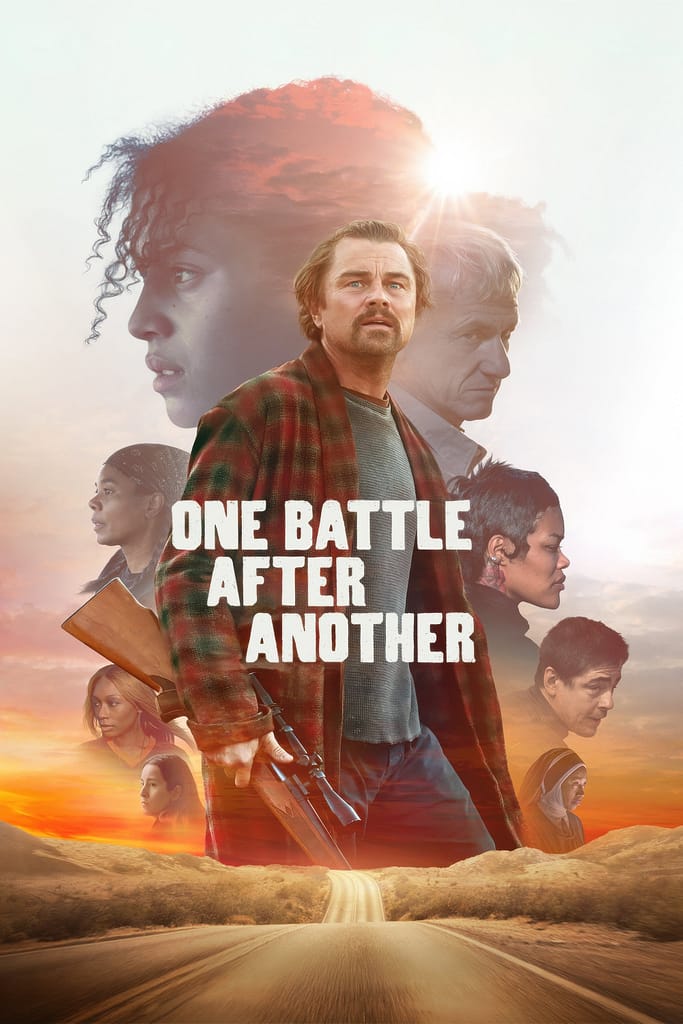




My quick rating – 7.7/10. One Battle After Another throws you straight into the muddled, smoky headspace of Bob (Leonardo DiCaprio), a washed-up revolutionary who’s been living off-grid long enough to forget what year it is. His daughter Willa (Chase Infiniti) is the one actually keeping their little two-person fortress running, a sharp, resilient counterweight to Bob’s stoned paranoia. Paul Thomas Anderson wastes no time establishing the family dynamic, giving us a quick, efficient rundown of Bob’s turbulent past with Willa’s mother, Perfidia (Teyana Taylor). It’s the kind of opening that feels like a creative necessity. Get the emotional scaffolding in place and then get on with the chaos.
It doesn’t take long before Sean Penn arrives as Colonel Lockjaw, and yes, he shows up with a full, unapologetic boner, because of course he does. Penn chews into this role like it’s been waiting for him his whole life, and he walks away with the film’s best performance. Anderson mentioned it took him about twenty years to write One Battle After Another, a process that he calls both embarrassing and philosophically necessary. Watching the film, you can see why. It’s sprawling, ambitious, and clearly infused with the literary fingerprints of Thomas Pynchon’s Vineland. There’s even a major sequence reportedly written in one marathon night with Benicio del Toro, which honestly tracks with the film’s fever-dream logic.
The acting is phenomenal where it counts. Infiniti absolutely holds her own, matching DiCaprio’s tired paranoia with grounded energy. Penn, again, is operating at a level that almost feels unfair. Del Toro does exactly what he’s asked to – it’s just that the role doesn’t ask much of him. And that’s a recurring issue: most of the cast is solid, but they aren’t given the depth or the range to show off anything beyond competence.
Still, this story is written in a way that keeps you hooked through its full 162-minute runtime. It’s better than most of what’s come out this year, even if it’s not the flawless masterpiece some people are desperately labeling it as. Anderson doesn’t miss often, and he doesn’t miss here either, but the film meanders between tones and genres. It dips into comedy and satire, embraces bursts of action at the right moments, and shifts its thematic focus from rebellion and racism to the influence of shadowy organizations convinced they’re preserving “balance.” It’s messy, but in that intentionally layered, meticulously edited PTA style that somehow still feels effortless.
The cinematography is gorgeous – those road shots belong on a wall – and the film’s visual language sells the tug-of-war between power, corruption, and legacy better than any monologue could. Does it deserve a Best Picture nomination? Yes. Should Anderson and Penn be in their respective races? Absolutely. But don’t walk in expecting a 10/10 life-altering masterpiece. This is a great movie, not a perfect one. Temper the hype, sit back, and enjoy a filmmaker who still knows how to swing for the fences.