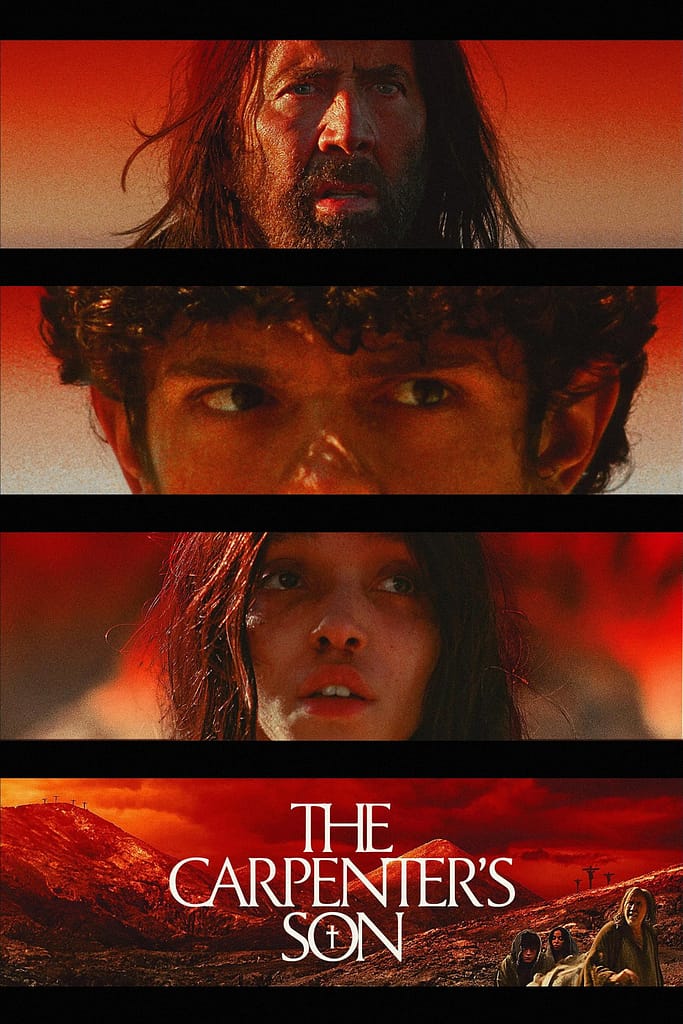




My quick rating – 3.8/10. I knew The Carpenter’s Son was going to be wrapped in controversy, whispers of blasphemy, and marketing hype that promises far more horror than the movie ever actually delivers. Directed and written by Lotfy Nathan and based on the apocryphal Gospel of Thomas, the film revisits the childhood of Jesus Christ through a darker lens, one that is clearly meant to unsettle. Whether it succeeds depends largely on what you’re expecting going in. I personally missed all the negative press down here, so I had hardly any expectations.
Set in Roman-era Egypt, the story follows a carpenter, his wife, and their young son, known only as “the Boy” (Noah Jupe) – as they live in hiding while supernatural forces circle closer. Nicolas Cage plays the Carpenter with a constant air of nervous restraint, a man weighed down by fear, responsibility, and an unspoken truth. The Boy, meanwhile, begins to question his guardian and rebel, discovering mysterious abilities that hint at something far beyond a normal coming-of-age arc. As these powers surface, the family finds itself facing both natural and divine horrors, eventually tipping the film into what could generously be called spiritual warfare.
I thought that the setting was one of the movie’s strengths. It is a dark, persuasive portrayal of living through such times. Both physically, with regard to lighting, sound, and so on, the movie often looks excellent, and the ambition of what is trying to be done is certainly evident. It is this notion that epic characters can be captured with raw humanity that the movie reveals with the greatest clarity of purpose. The father’s worry, mother’s stoic power, or boy’s temptation/rebellion are depicted effectively enough, aided by sound performances from everyone involved.
That said, the film has a major problem: it’s boring. For a movie that was hyped in some circles as shocking or terrifying, there’s very little here that qualifies as horror. Any “divine” threat remains largely abstract, and the sense of danger never truly escalates into something visceral or frightening. I can safely say the PR backlash and outcry surrounding the subject matter is by far the most intense thing about this release. This is not an early-Christ splatter film. Not even close. It plays more like a somber, slow-burn coming-of-age story with religious overtones – which, frankly, should surprise no one.
Interestingly, Isla Johnston’s Stranger is by far the most compelling character in the film. Whenever she’s on screen, there’s a spark of unpredictability and tension that the Boy himself often lacks. Her presence hints at a more unsettling movie lurking just beneath the surface, one that I never saw.
Ultimately, The Carpenter’s Son is an ambitious but uneven film. It will absolutely be a love-it-or-hate-it experience, largely because many viewers will judge it solely on its religious material. Some will cry blasphemy, others will embrace it simply because it challenges Christian iconography. Stripping all that away, what’s left is a thoughtfully made but underwhelming flick that succeeds more as a moody historical drama than as a horror movie. And judging it purely on its merits, not its controversy, it simply doesn’t have the bite its reputation suggests.